Review of Mãrama by Bryan Kamaoli Kuwada (Kanaka ʻŌiwi)
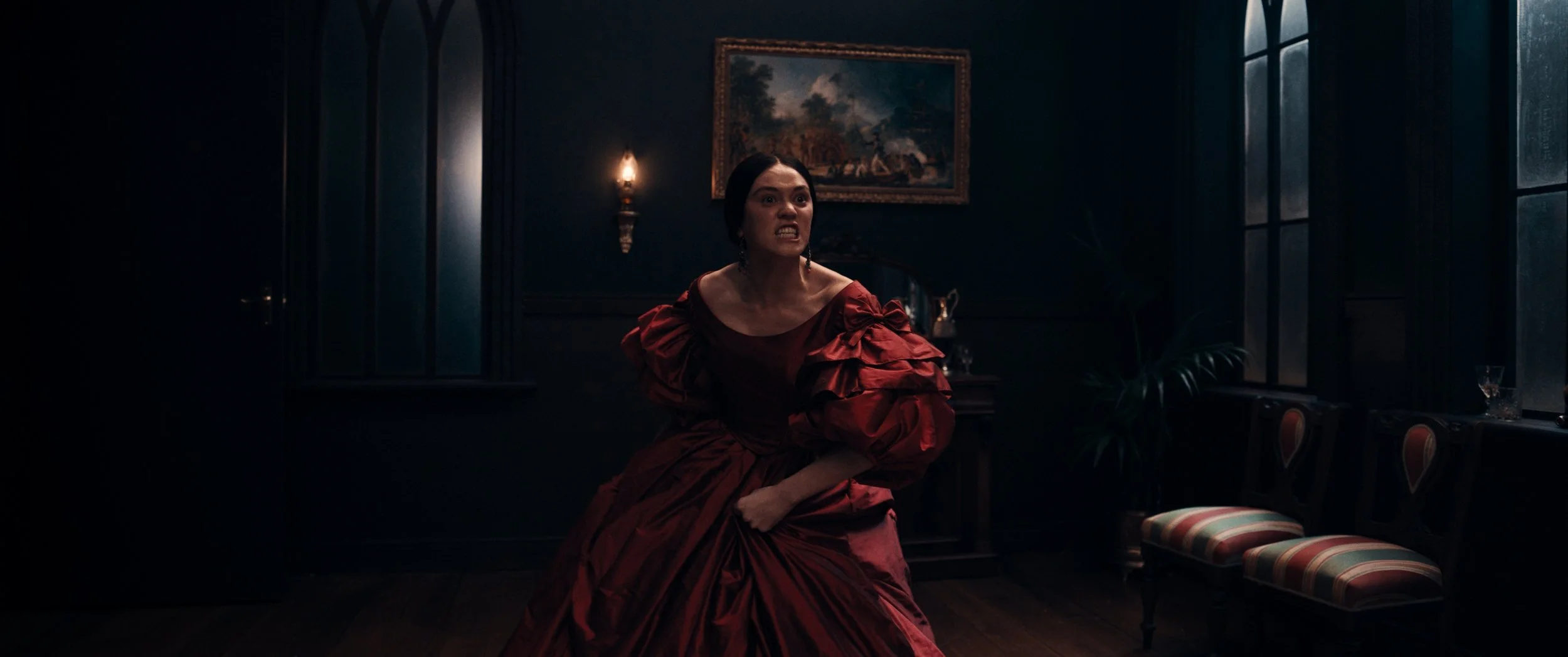
Mārama | Directed by Taratoa Stappard (Ngāti Raukawa, Ngāti Toa, Ngāti Tūwharetoa)
AOTEAROA NEW ZEALAND | 2025 | 89M | ENGLISH, MĀORI
There is a stone heart beating at the core of Taratoa Stappard’s brave and stunning debut feature Mārama. In this layered and complex period thriller, Mārama, a young Māori woman in 1859 (brilliantly portrayed by Ariāna Osborne), is 11,000 miles from home, searching for answers about her family in England. The film does so many things well, but one vital thing that it does is that it forces you to listen, not just to its critiques of colonialism and heteropatriarchy, but to the soundworld it creates. And that is where, as a Kanaka Maoli, I find a great deal of the film’s power.
The sound design is spare and each old-mansion creak and dark-hallway footstep pulls you deeper into the gothic world Stappard has meticulously constructed. But underneath the restrained politeness and genteel manners, there is an ever-present stone rhythmic beat, tapping, tapping, tapping. And that this easily missed element is one of the most important, because it is the voice of the land itself.
The first tapping beats open the film, literally grounding us as the audience. The pulse of stone sounding against stone continues throughout, the land always speaking, always calling. It sounds a quiet warning when Nathaniel, the film’s whaling magnate villain, first touches Mārama. The stones tap insistently when she first sees the kidnapped and uprooted wharenui and then grows into the visceral sound of stone grinding on stone when we see the wharenui at night wrapped in the fertile generativity of the darkness called pō. These sounds are the land calling from 11,000 miles away, rooting Mārama in her connection to her land that is so far and to her family members that are so close.
The stone tapping is not quite diegetic though Mārama’s mother Hinemoana is likely the one creating the sound, as we see and hear her in Mārama’s vision with the stones in her hand. We also hear a wooden tapping as the grandmother Arorangi uses the striking stick to hit the wooden-handled bone needle as she tattoos Hinemoana. The sounds of stone and wood resonate through generations, the power and teachings that come from the land amplified and passed down to Mārama. These generational echoes contrast with the foreign beat of colonialism and male violence, the dull thump and squelch of the flensing blade cutting through whale or Nathaniel’s fists pounding on flesh. They are the transmission of relationships that are not founded in violence, which is why the climax of the film is not the bloody-yet-satisfying scenes when Mārama kills Nathaniel and Jack but the quieter moments just after, when Mārama is able to re-enter into relationship with her family and return them home.
This film is a clear critique of colonialism and within that an assertion that the real horror is being separated from our people and our home (kainga/ʻāina/henua/honua/whenua). But even within the horror, within the violence, there is a quiet tapping, trying to get our attention, trying to remind us of an important lesson: our power is in the land and the relationships that have grown from it, no matter how far away. And perhaps that is the heartbeat of what will save us all in the end.
Review by Bryan Kamaoli Kuwada (Kanaka ʻŌiwi)
