Review of Meadowlarks by Bryan Kamaoli Kuwada (Kanaka ʻŌiwi)
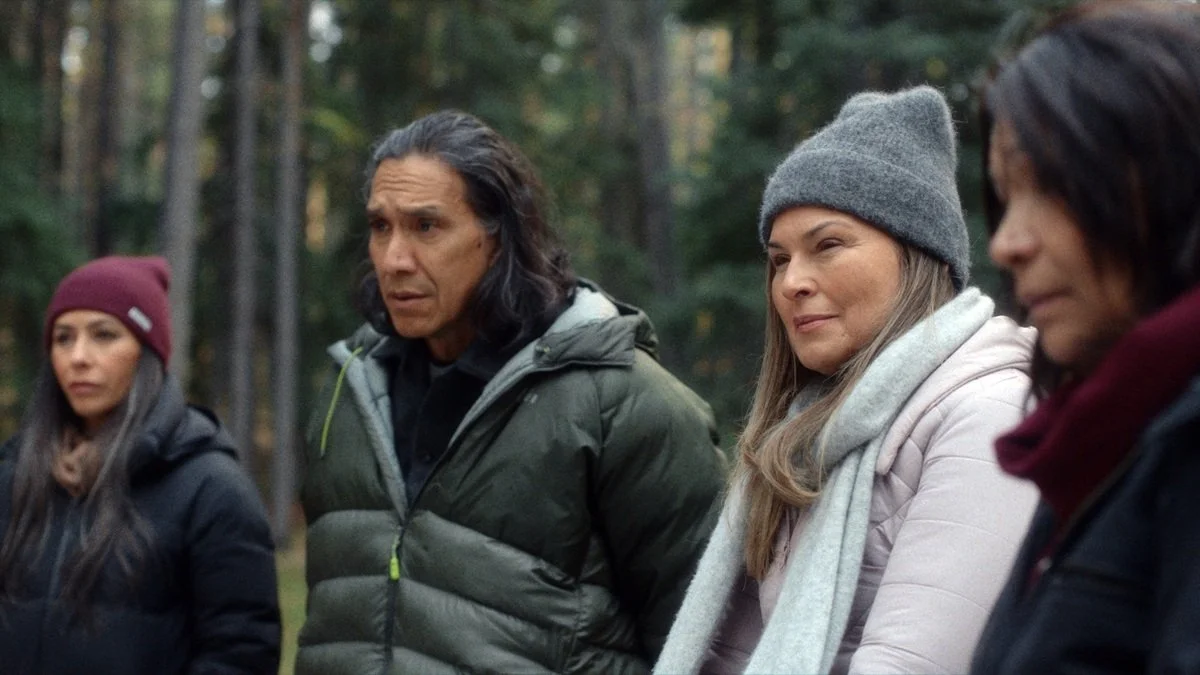
Meadowlarks | Directed by Tasha Hubbard (Cree)
CANADA | 2025 | 91M | ENGLISH
Meadowlarks, Cree filmmaker Tasha Hubbard’s first narrative feature, is a powerfully affecting film full of echoes and silences. Four Cree siblings meet for the first time since they were torn apart by the Sixties Scoop and try to forge familial bonds over a long weekend in Banff.
This gut-wrenching but ultimately hopeful film brought to mind Leanne Simpson’s poem “i am graffiti”: “we are the singing remnants / left over after / the bomb went off in slow motion / over a century instead of a fractionated second.” Though this poem is more connected to the TRC, both the singing remnants and the bomb echo throughout Hubbard’s narrative. The siblings–Connie, Gwen, Anthony, and Marianne–are dealing with the shrapnel, injured in ways unseen and unexpected, but also singing quiet songs (quite literally in Anthony’s case) to bring about healing.
Another echo is that Meadowlarks is based on Hubbard’s loving documentary Birth of a Family. It is uncommon to see an artist adapting their own work, and it was especially powerful how the story beats shifted and blossomed from documentary to narrative feature. The films share the same heart, but where Birth of a Family kept a critical distance from the siblings’ interactions to mitigate documentary intrusiveness, much of that distance is gone in Meadowlarks. It is much messier. We get to see how awkward and painful many of their interactions are, but the closer focus also gives us a deeper experience of their hope and connection. This approach maybe even makes the characters more human.
Amidst these echoes too are silences. The quiet hurt when Marianne first tries on beaded earrings and feels the hole where her family memories and culture are supposed to be. The siblings’ hesitant motions during the smudge. But also the way Anthony nonchalantly eats Connie’s burnt cookies. Or how Gwen silently places their absent brother’s jersey near their parents’ picture.
I watched Meadowlarks at imagineNATIVE and heard discussions around “traumatainment” and many were critical of Indigenous trauma in storytelling as almost a plot device. As a Kanaka Maoli, I do not know enough to weigh in about this difficult topic or how this film fits into these discussions, but I will say that while there was indeed a lot of trauma portrayed in this film, I also saw so much healing as well (oh man, the skybridge scene!). In Hawaiʻi, we have something called the wā, which is the space between: between ourselves and other people, between us and our culture, even between us and time. I think that the wā is the kind of silence portrayed in the film, because although there is an absence there, the space is full of possibility. The wā can be filled with connection, with growth, with love.
That is not to say that healing is easy. I do not think that Meadowlarks ever makes that statement. Instead, it is messy, difficult, sometimes ugly. It moves in fits and starts, even taking us back to places we don’t want to be. But healing happens. And Hubbard doesn’t go for a pat resolution at the end. Tensions still exist. Wounds still hurt. We are not privy to plans for them to meet again. Nevertheless seeds have been planted in the echoes and the silence. And as the titular meadowlarks know, even after the longest winter, we can sing a song to fill the silence and celebrate what has grown.
Review by Bryan Kamaoli Kuwada (Kanaka ʻŌiwi)
